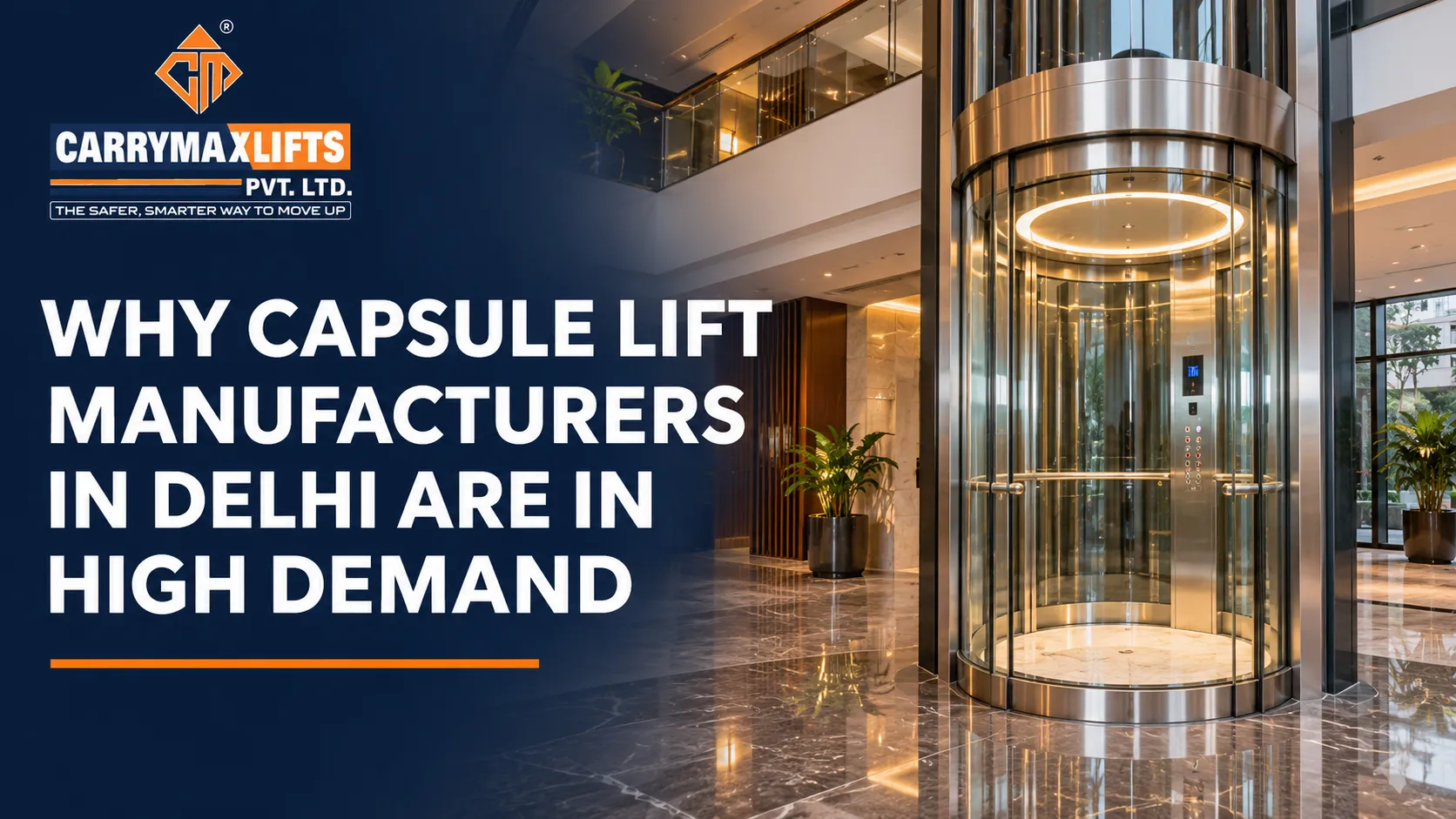
Walk through any new mall in West Delhi, a boutique hotel in Aerocity or a showroom on a busy Karol Bagh road and you'll often see a glass lift gliding up the front of the building. Ten years ago, a lift like this was a rare luxury. Today, capsule lift manufacturers in Delhi get enquiries from mall developers, hotel owners, hospital groups, corporate offices and even families building premium homes.
If you're planning a building in Delhi and wondering whether a capsule lift fits your project, this guide explains what is driving the demand, where capsule lifts work best, what Delhi's rules require, and how to choose the right manufacturer.
At Carrymax Lifts, we design, manufacture, install and maintain capsule lifts for projects across Delhi NCR from our head office and experience centre in IMT Faridabad. What follows comes from the questions our clients ask us most often.
What Is a Capsule Lift?
A capsule lift, also called a panoramic lift, observation lift or glass capsule elevator, is a passenger lift with a cabin that is mostly glass. Passengers can see outside as they travel, and people outside can see the lift moving. It can run inside an atrium, in an open lobby or on the outside face of a building.
Carrymax capsule lifts come in three main cabin shapes:
- 3-side glass capsule: glass on three sides, with the fourth side against the building or shaft wall
- 5-side glass capsule: a faceted cabin that gives a wider view and a striking look from outside
- Round capsule: a fully curved cabin, often used as the centerpiece of a mall or hotel atrium
Our standard capsule lifts carry 8 to 20 persons at speeds of 0.5 to 1.5 m/s, depending on the building height and expected traffic.
Why Demand for Capsule Lifts Is Rising in Delhi
Commercial buildings are competing on looks
Delhi's retail and hospitality market is crowded. A mall in Rajouri Garden, a hotel near IGI Airport or an office tower in Nehru Place all compete for the same visitors and tenants. A capsule lift is one of the few building features that does two jobs at once: it moves people, and it turns a facade or atrium into something people notice and remember.
Developers tell us a glass lift on the street-facing side works like a lit-up signboard after dark. That is a big reason commercial lift suppliers in Delhi now get more requests for capsule designs than for plain enclosed cabins in public-facing projects.
Space is tight, so lifts are moving outside
Many Delhi plots are narrow, and every square foot of carpet area matters. Because a capsule lift can run on the outside face of a building, it can free up space inside that a conventional shaft would take. For older buildings being modernized, an external capsule lift is often the only practical way to add a lift without cutting through every floor.
Hotels, banquet halls and restaurants want a "wow" arrival
Rooftop restaurants, banquet halls and hotels on Delhi's main roads use capsule lifts to turn the ride up into part of the experience. A guest riding a glass lift to a rooftop venue sees the city on the way up, and that first impression helps the business.
Premium homes and builder floors want light and openness
Across South Delhi, West Delhi and the farmhouse belts of Chhattarpur and Westend, families are building or rebuilding multi-floor homes and builder floors. Many want a lift that feels open rather than boxed-in. Glass cabins let daylight into the stairwell, make compact spaces feel larger and fit modern interiors.
For smaller residences, our engineers check whether a capsule cabin suits the available space or whether a compact passenger lift or a platform lift would serve the family better. Our one person lift for home guide and home lift price in India breakdown cover those options in detail.
Accessibility is now expected, not optional
Delhi's population includes a growing number of senior citizens, and buildings are under pressure to be accessible to everyone. Capsule lifts give elderly visitors, wheelchair users and parents with strollers easy access between floors. They also feel less confined than enclosed lifts, which helps passengers who are uneasy in small spaces.
Modern drive technology has made capsule lifts practical
Older glass lifts needed bulky machine rooms and used more power. Today's capsule lifts use gearless machines and machine room less (MRL) layouts that save space, run quietly and use less energy. Together with smart controllers, this makes a capsule lift a sensible choice for buildings that once couldn't fit one.
Where Capsule Lifts Work Best in Delhi
| Building type | Typical Delhi locations | Why a capsule lift fits |
|---|---|---|
| Shopping malls | Saket, Rajouri Garden, Vasant Kunj, Janakpuri | Atrium centerpiece, high footfall, brand appeal |
| Hotels and resorts | Aerocity, Mahipalpur, Connaught Place | Guest experience, rooftop and lobby access |
| Corporate offices | Nehru Place, Jasola, Okhla, Netaji Subhash Place | Premium image for tenants and clients |
| Showrooms and retail | Karol Bagh, Lajpat Nagar, Kirti Nagar | Facade visibility, multi-floor display space |
| Hospitals and clinics | Across Delhi | Visitor movement in lobbies (paired with stretcher lifts) |
| Premium homes and farmhouses | Chhattarpur, Westend, Greater Kailash, Punjabi Bagh | Natural light, open look, modern interiors |
| Restaurants and banquet halls | Main roads and rooftop venues across Delhi | Memorable arrival, city views |
Delhi Lift Rules You Should Know
In Delhi, lifts are regulated under the Bombay Lifts Act, 1939 (as extended to the National Capital Territory of Delhi) and the Delhi Lift Rules, 1942. These laws are enforced by the Electrical Inspectorate of the Labour Department, GNCTD, where the Electrical Inspector acts as the Inspector of Lifts.
In practice, the process works like this:
- Permission to erect: The building owner applies before installation. The application is checked against the Act and Rules before permission is granted.
- Installation: The manufacturer installs the lift according to the approved drawings.
- Inspection and licence to work: After an application in Form-B, the Inspector of Lifts inspects the lift. Once the inspector is satisfied the lift complies, a licence to work the lift is issued, usually within 15 days.
- Periodic inspection: The lift must keep meeting safety requirements to stay licensed.
A capsule lift has more parts to check than a standard lift, including the glass panels, structural frame and exposed guide rails. Choose a manufacturer that handles the drawings, documents and inspection support for you. Our lift inspection and safety checklist explains what inspectors look for.
Safety Features to Expect in a Capsule Lift
A glass cabin should never mean less safety. A properly engineered capsule lift from a reliable manufacturer should include:
- Toughened laminated safety glass that stays in place even if it cracks
- A strong structural steel frame designed for the cabin's load and Delhi's wind and weather on exterior installations
- Overspeed governor and safety gear to stop the car if it moves faster than it should
- Automatic rescue device (ARD) that brings the cabin to the nearest floor during a power cut
- Door safety sensors (light curtains) to prevent doors closing on passengers
- Emergency alarm, intercom and emergency lighting
- Overload sensing so the lift won't move when carrying too much weight
- Buffers in the pit and limit switches at the top and bottom of travel
Design work follows the relevant Bureau of Indian Standards (BIS) codes for lifts, and every installation is tested before handover. Our elevator parts guide explains each of these components in plain language.
What Affects Capsule Lift Price in Delhi
Capsule lift prices vary a lot from project to project, so be careful with any quote that gives a single number without seeing the site. The main factors are:
- Cabin shape: round and 5-side cabins need more glass and more complex fabrication than 3-side cabins
- Capacity and speed: an 8-person lift at 0.5 m/s costs less than a 20-person lift at 1.5 m/s
- Number of floors and travel height: more stops mean more rails, structure and wiring
- Installation location: an external facade lift needs a weather-resistant structure, while an internal atrium lift may need a glass shaft
- Glass specification: clear, tinted or frosted glass and the thickness of laminated panels
- Machine and controller: gearless MRL systems with advanced controllers cost more upfront and save energy over time
- Interior finish: stainless steel, gold or rose-gold finishes, flooring, lighting and car operating panels
- Civil work: pit, foundation and any structural changes the building needs
For planning dimensions and pit and headroom needs, see our lift size and dimensions guide. If you're choosing between drive systems, our comparison of traction vs hydraulic elevators explains why traction drives are standard for capsule lifts.
How to Choose the Right Capsule Lift Manufacturer in Delhi
The rise in demand has also brought in suppliers who resell imported cabins with little local support. Before you sign, check these points:
- Manufacturing capability: Does the company build lifts in its own facility, or only trade and install?
- Capsule lift experience: Ask to see completed glass lift projects and visit one if you can.
- Engineering support: A good manufacturer reviews your structure, prepares layout drawings and coordinates with your architect.
- Licensing help: Make sure they handle the paperwork and inspection support needed under Delhi's lift rules.
- Local service network: Breakdowns need quick response. A team based in Delhi NCR makes a real difference.
- Clear, itemized quotes: Every major cost should be listed, including glass, structure, machine, controller and civil requirements.
- Annual maintenance: Ask what an AMC covers, how often visits happen and how fast emergency calls are answered.
We've written more on this in safe elevator suppliers in Delhi for tall buildings.
Why Delhi Builders Choose Carrymax Lifts
Carrymax Lifts is a lift manufacturer headquartered in IMT Faridabad, with an experience centre where you can see our cabins, finishes and machines in person before you decide. We work across Delhi and the wider NCR, along with Haryana, Punjab and Uttar Pradesh. As established lift manufacturers in Delhi and NCR, we offer:
- Custom capsule designs: 3-side, 5-side and round cabins sized to your building
- In-house engineering: structural layouts, glass specification and shaft planning
- End-to-end installation: from site survey to testing and handover
- Licensing support: documents and inspection coordination as per Delhi rules
- Comprehensive maintenance: preventive AMC and fast breakdown response
- Customer support and consultation: honest advice on whether a capsule lift is right for you, or whether another lift type suits better
Our complete range of lifts and components
A building rarely needs only one kind of lift. Alongside capsule lifts, Carrymax manufactures:
- Passenger lifts for residential towers, offices and commercial buildings
- Hospital and stretcher lifts for hospitals, nursing homes and clinics
- Freight and goods lifts for warehouses, factories, showrooms and malls
- Machine room less (MRL) lifts for buildings with limited overhead space
- Platform lifts for homes and low-rise buildings that need a simple, accessible solution
- Gearless machines for quiet, energy-efficient operation
- Geared machines for heavy-duty and cost-conscious projects
- Integrated serial and parallel controllers for smooth, reliable lift control
Our services cover custom lift solutions, expert installation, comprehensive maintenance, safety assurance and technology upgrades. Details on our door options are in our guide to types of lift doors.
Serving Delhi and across the NCR
Besides Delhi, we serve clients in Noida, Greater Noida, Ghaziabad, Sonipat, Palwal, Panipat, Karnal and Chandigarh.
Plan Your Capsule Lift With Carrymax
A capsule lift is a long-term investment in how your building looks, how visitors move through it and how it's valued. Before you settle on a design, have an engineer check your structure, space and traffic. Our team will visit your site, recommend the right cabin shape and capacity, and give you a clear, itemized quote.
Call, email or visit us to book a free site survey.
Phone: +91 92117 97919 | +91 98734 98314
Email: info@carrymaxlifts.com
Head Office: Plot No. 411-A, Sector 68, IMT, Faridabad, Haryana 121004