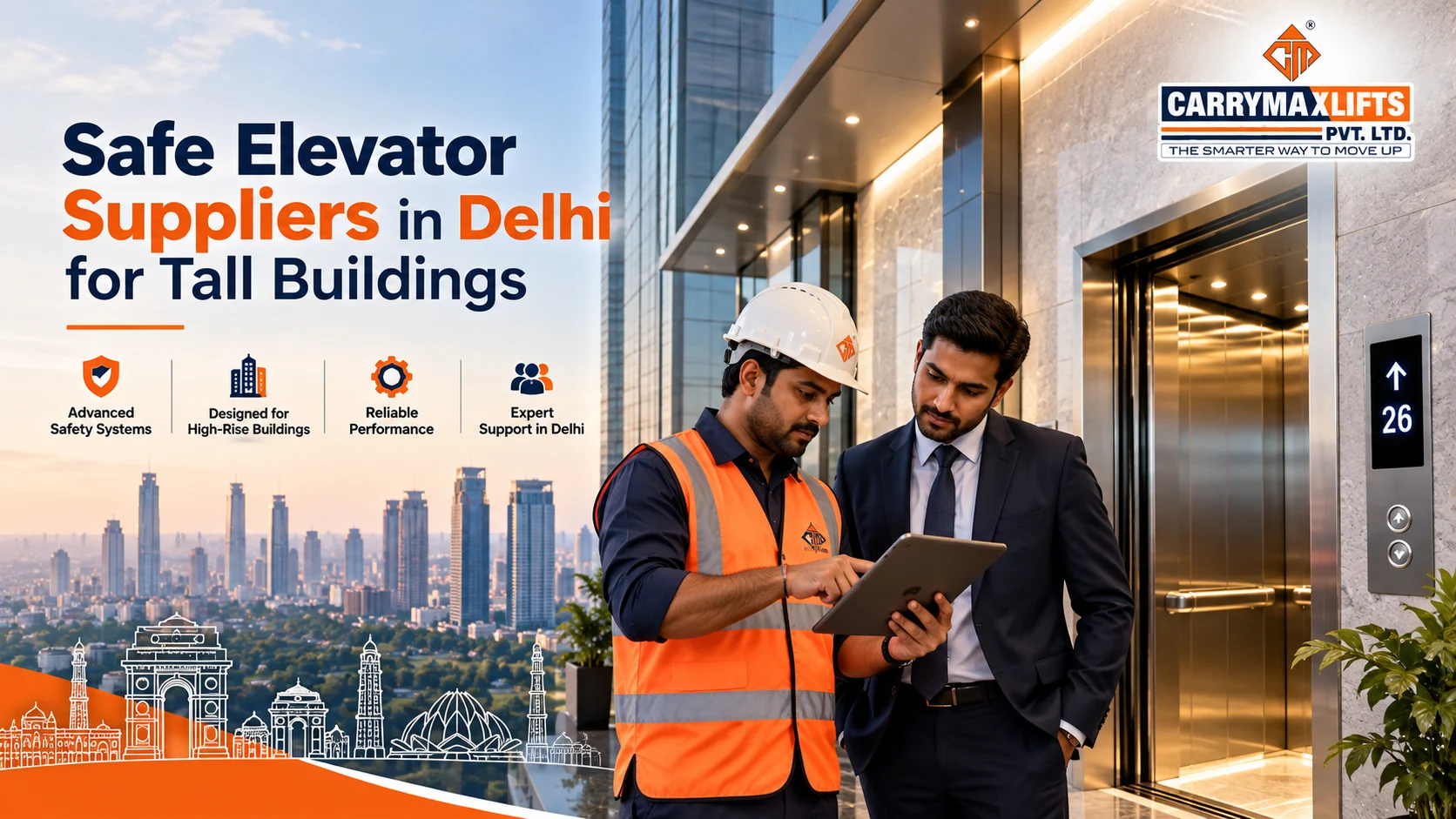
How to choose safe elevator suppliers in Delhi for tall buildings: fire lift and earthquake requirements, rescue and safety features, approvals, and eight questions to ask before you buy.
Delhi sits in Seismic Zone IV, and fire rules generally treat any building taller than 15 meters as high-rise. Those two facts change what a lift must do. In a tall building, one shaft can serve as a firefighter’s route to the upper floors and as the daily route for hundreds of people.
If you are a developer, architect, or facility head choosing lifts for a tall building, your real question is who can supply lifts that pass inspection, handle peak traffic, and stay in service. This guide helps you find Safe Elevator Suppliers in Delhi. It explains what tall buildings require, how Lift Manufacturers in Delhi differ from dealers, and which checks protect you before you sign. It also shows where Carrymax Lifts fits and where you should ask harder questions.
What Counts as a Tall Building for Lift Planning
In Delhi, the 15-meter mark matters most. Buildings taller than that are generally treated as high-rise under Part 4 of the National Building Code of India, 2016 and the Delhi Fire Service Rules. High-rise buildings need fire department clearance, and the lift arrangement is usually part of that review. Exact triggers vary with occupancy, so confirm them with your architect and fire consultant before you fix a lift specification.
Height also changes the engineering. Longer travel calls for higher speeds, closer attention to ride quality, and a bigger consequence when one car goes out of service. Heavy traffic at office start and closing times can overwhelm a lift bank sized by floor count alone. A tall building needs a supplier who plans traffic, safety, and servicing together, not one who only quotes a car.
How Traffic and Speed Shape Lift Selection
Part 8, Section 5 of the National Building Code covers the installation of lifts and escalators, including how many lifts a building needs and how large and fast they should be. The starting point is population. An office tower and a residential block of the same height need different lift banks, because their occupants travel at different times and in different volumes.
Waiting time is the practical test. A lift bank that leaves crowds in the lobby at peak hour draws complaints from the first week. Ask your consultant for a traffic study, then hold every supplier to the same figures for capacity, speed, and number of cars. A supplier who proposes a lift count without asking about occupancy has not done the sizing.
Safety Features Tall Buildings Should Demand From Their Lifts
Safe Elevator Suppliers in Delhi build these protections into the quote instead of listing them as extras. Use the sections below to test every proposal you receive.
Fire lift and fire-rated enclosure
The National Building Code expects at least one fire lift in buildings taller than 15 meters, with a fire-rated shaft, a protected lobby, and a power supply that keeps working during a fire. Delhi’s building bye-laws call for two-hour fire ratings on lift enclosure walls and lobbies in high-rise buildings. In normal use, the fire lift also works as a regular passenger lift, so you do not lose capacity. Ask your supplier to name which car is the fire lift and how it switches to firefighter control.
Earthquake readiness
Delhi lies in Seismic Zone IV, according to the Ministry of Earth Sciences. A seismic sensor can detect tremors and typically stops the lift at the nearest floor with the doors open, so passengers can leave. Ask whether a sensor is included, how it connects to the controller, and what inspection must happen before service resumes. Passengers should still use the stairs, not the lift, to evacuate during an earthquake or fire.
Power failure and rescue
A tall building cannot leave passengers stranded between floors when the power drops. On gearless machines, a spring-applied brake engages during a power failure and holds the car in place, as the gearless machine page from Carrymax Lifts explains. An automatic rescue device then moves the car to the nearest floor and opens the doors. Emergency lighting, an alarm, and two-way communication keep trapped passengers informed until help arrives.
Core protective devices
Every lift in a tall building should also carry the basics, and the quote should name each one:
- an overspeed governor and safety gear that stop the car if it travels too fast
- door interlocks that prevent movement while a door is open
- buffers in the pit
- controller protection against under-voltage, over-voltage, and earth faults
- a fault display that helps technicians diagnose problems quickly
Ride quality and traffic handling
Gearless drives suit tall buildings because they run quietly and smoothly. A variable frequency drive controls acceleration, so the ride stays comfortable at every stop. For a bank of several lifts, ask how the controller coordinates the cars. Carrymax describes an integrated serial and parallel controller that supports single speed, two speed, or variable frequency drive operation.
Lift Manufacturers or Elevator Dealers: Which Suits a Tall Building?
Lift manufacturers build and service their own equipment, so one party stays accountable for design, fabrication, and warranty. They can also adapt car sizes and finishes to the awkward shafts common in Delhi buildings. Elevator Dealers in Delhi usually represent larger brands, some of which offer high-speed lifts for very tall towers. The trade-off is that spare parts and technician support depend on the brand behind the dealer.
Neither route is automatically safer. What matters is evidence. Has the supplier installed lifts at your height, with your fire and earthquake requirements, in Delhi NCR? Ask for reference sites, visit one, and speak with its facility manager. Our guide to where to find commercial lift suppliers in Delhi covers the wider search.
Some projects split the package between a dealer for the main passenger bank and a manufacturer for service, goods, or fire lifts. Whatever mix you choose, name one party as accountable for the whole vertical transport system.
How to Shortlist Lift Manufacturers in Delhi for a Tall Building
Start with documents. Ask each supplier for the following:
- test certificates for the governor, safety gear, and door interlocks
- drawings that state pit depth, overhead height, shaft size, and machine-room needs
- a list of installed lifts with building heights and completion years
Next, visit the factory or a live installation. Look at weld quality, panel finishing, and the testing area, and note whether safety parts sit in stock. Apply the same test to Elevator Dealers in Delhi by asking which brand’s factory and service team backs the lifts, because a dealer’s promise is only as strong as that brand’s support in NCR. Finally, call two building managers who use the supplier’s lifts today and ask how breakdowns were handled.
Comparing Proposals Fairly
Send every supplier the same specification sheet: floor count, travel height, capacity, speed, door type, fire lift requirement, and control system. Then compare scope line by line. Tall building proposals often differ on civil requirements such as pit depth and overhead height, on whether seismic sensors and rescue devices are included, and on who supplies temporary power and scaffolding during installation. The lowest price often leaves out a safety item or a service term.
Where Carrymax Lifts Fits in a Tall Building Project
Carrymax Lifts is a Faridabad-based manufacturer with its registered office and experience centre at Plot 411-A, Sector 68, IMT Faridabad. Its passenger lifts page lists cars for 4 to 20 persons, from 272 to 1,360 kg, at speeds up to 1 m/s. The range also includes gearless and geared machines, machine-room-less lifts, and hospital lifts.
Those published specifications point to a good fit for low-rise and mid-rise commercial buildings, residential societies, hospitals, and showrooms. A speed of up to 1 m/s generally does not suit long-travel towers. A developer planning a taller project should ask Carrymax about higher-speed options, the tallest installation it has completed, and reference sites in Delhi NCR. That same question applies to every supplier on your list.
The company also describes an installation background, having started as an erection and commissioning contractor for established manufacturers. These details come from the company’s own website and profile, so verify them with a factory visit and conversations with existing clients.
Delhi Approvals That Affect Lifts in Tall Buildings
Lifts in Delhi fall under the Electrical Inspectorate of the Delhi Labour Department. It enforces the Bombay Lifts Act, 1939 as extended to Delhi, along with the Delhi Lift Rules, 1942. The owner applies to the Inspector of Lifts for permission to erect a passenger lift, informs the inspector after installation, and receives a license to work the lift once it passes inspection.
Your supplier’s paperwork discipline matters here. In a tall building, a delay at inspection holds up occupancy for the whole project, not for one lift. Ask who prepares the drawings, who files the applications, and who attends the inspection, and get the answers in writing. Rules, forms, and fees change, so confirm current requirements with the Electrical Inspectorate and your fire consultant.
Eight Questions for Suppliers of Tall Building Lifts
Put these to manufacturers and dealers alike, and keep the written answers:
- What is the tallest building where you have installed lifts, and can I visit it?
- What speed, capacity, and travel height does this lift offer, and how did you size the lift bank for my peak traffic?
- Which car is the fire lift, and how does it meet NBC 2016 Part 4 and Delhi Fire Service requirements?
- Is a seismic sensor included, and what happens after an earthquake event?
- Does the lift include an automatic rescue device, emergency lighting, and two-way communication?
- Which brands supply the machine, controller, ropes, and door operator, and are spares stocked in NCR?
- What is your breakdown response time, including nights and holidays, and who is on call?
- Who handles the drawings, the Inspector of Lifts approval, and the handover tests?
Planning Maintenance for Tall Buildings
A single stalled car in a tall building can push the rest of the lift bank past its limit at rush hour. Maintenance is therefore part of the safety plan, not an afterthought. Sign an annual maintenance contract at handover that states visit schedules, covered parts, response times, and a named engineer.
Ask whether the company that installs the lift will also service it. One accountable party avoids finger-pointing when a fault appears. Keep license and inspection dates in a shared calendar, because a lapsed license is a compliance problem and a liability risk for the owner.
Conclusion
Safe Elevator Suppliers in Delhi prove their claims with fire-lift documentation, earthquake and rescue provisions, reference installations at your height, and a clear service plan. Lift Manufacturers in Delhi and Elevator Dealers in Delhi can both deliver a safe lift. The difference lies in evidence and accountability.
Your next step is to shortlist three suppliers, send each the same specification, and ask the eight questions above. Visit a live installation before you commit.
Planning lifts for a building in Delhi NCR?
Share your floor count, travel height, and traffic needs for a site-specific recommendation from Carrymax Lifts.