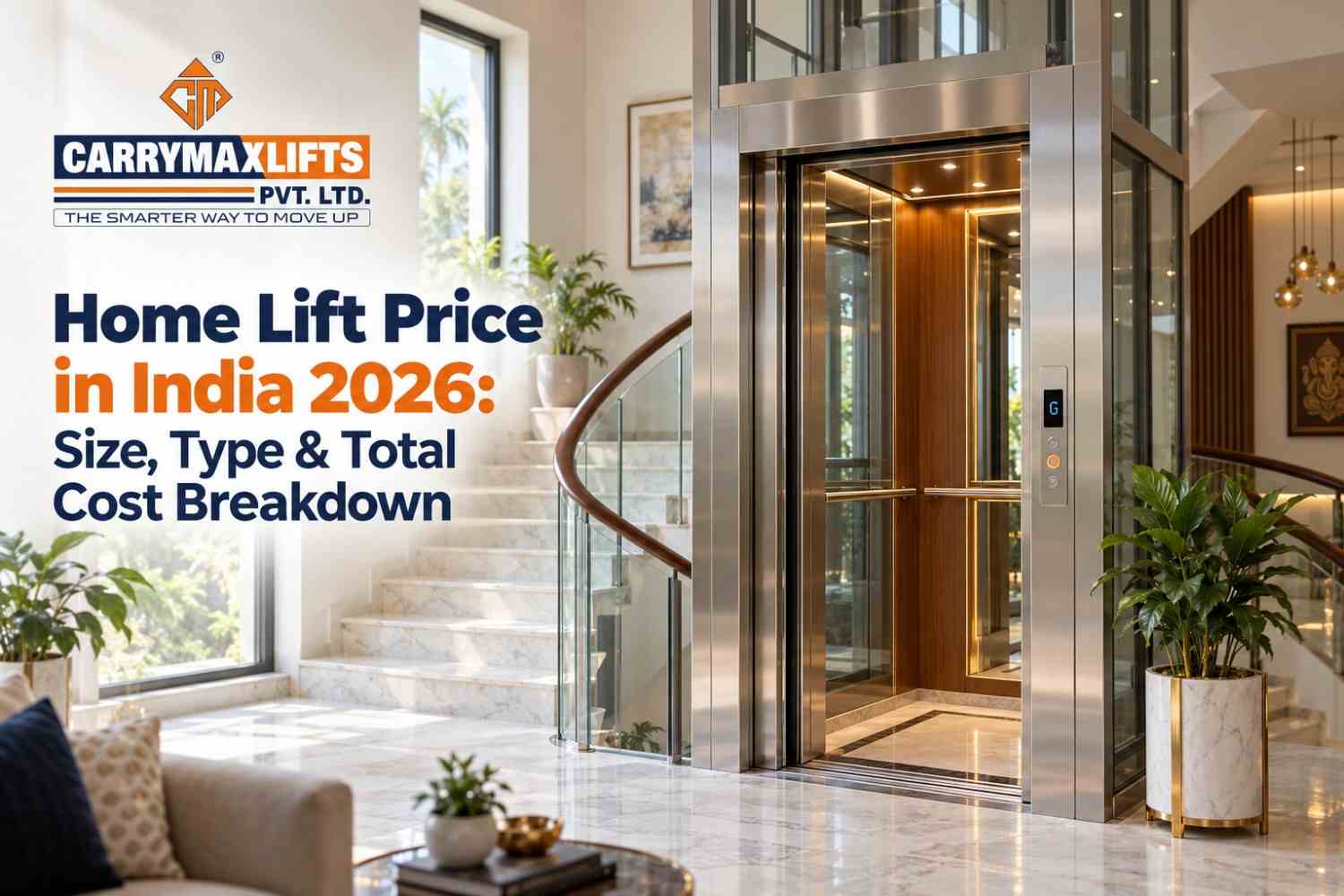
Home Lift Price in India 2026A complete 2026 pricing guide to home lifts in India — covering traction, MRL, gearless, and capsule lift costs, what drives the price, hidden charges to budget for, and how Carrymax Lifts compares to other brands.
If you're searching for the home lift price in India, here's the short answer: a residential lift in 2026 typically costs between ₹12 lakh and ₹35 lakh, depending on the lift type, number of floors, cabin size, and finish. Compact traction units for a single floor start lower, while premium gearless or capsule-style lifts with full customisation can go well beyond ₹35 lakh.
At Carrymax Lifts, we get asked this question almost every day — by homeowners planning a new build and by families retrofitting a lift into an existing house. This guide breaks down exactly what drives that price, how it compares across lift types, and what you should budget for beyond the quotation itself.
Home Lift Price in India at a Glance (2026)
Use this table as a starting reference. Final pricing always depends on your site, floor count, and customisation, but this gives you a realistic planning range.
| Lift Type | Typical Capacity | Price Range (2026) |
|---|---|---|
| Traction/MRL home lift | 3–6 persons (272–408 kg) | ₹12 lakh – ₹25 lakh |
| Gearless traction lift | 4–6 persons | ₹15 lakh – ₹28 lakh |
| Capsule/panoramic lift | 4–6 persons | ₹18 lakh – ₹35 lakh |
| Small/compact home lift (retrofit) | 1–2 persons | ₹12 lakh – ₹18 lakh |
These are approximate market ranges for planning purposes. Get an exact quote based on your building's floor count, shaft availability, and finish preferences.
What Decides the Price of a Home Lift?
No two quotations look the same because pricing is built from several independent variables. Here's what actually moves the number.
Number of Floors and Travel Height
Every additional floor adds travel height, an extra landing door, more wiring, and additional structural work. As a rough rule, each extra floor beyond the first adds anywhere from ₹1.5 lakh to ₹3 lakh to the base price, depending on the lift type.
Capacity (2, 3, 4, 6 Persons)
A 2–3 person lift (around 270 kg) is the most affordable option and works well for individual use or elderly accessibility. A 4–6 person lift (320–408 kg) suits families and costs more due to a larger cabin, stronger drive system, and wider shaft requirement.
Drive Type — Traction, Gearless, MRL
This is the single biggest price driver. Standard traction lifts are more budget-friendly, while gearless and Machine-Room-Less (MRL) systems cost more upfront but run more efficiently, more quietly, and need less maintenance over the lift's lifetime. If you're unsure which suits your building, our gearless machine and geared machine pages break down the technical differences.
Cabin Finish and Door Type
Standard laminate cabins cost the least. Glass panels, stainless steel, wood-finish interiors, automatic doors versus manual collapsible gates — each upgrade adds to the final bill, sometimes by ₹1–3 lakh depending on the extent of customisation.
Shaft — Existing vs Newly Constructed
If your home already has a lift shaft built in, you save significantly on civil work. Retrofitting a lift into an existing staircase or a self-supporting structure (no shaft) usually costs more due to additional structural engineering.
Price by Lift Type
Traction/MRL Home Lift Price
Machine-Room-Less (MRL) traction lifts are the most common choice for Indian homes today, suiting everything from 2-floor duplexes to taller 4+ floor houses, with smooth, quiet rides and lower long-term power consumption. Pricing typically falls between ₹12 lakh and ₹25 lakh. See our Machine Room Less (MRL) lifts for technical specifications.
Gearless Traction Lift Price
Gearless machines offer the smoothest ride quality and the lowest long-term maintenance, since there are fewer moving parts to service. They're a popular upgrade for taller homes and premium villas, generally priced between ₹15 lakh and ₹28 lakh. Explore our gearless machine range for load and speed options.
Capsule/Panoramic Lift Price
Capsule lifts, with their glass cabin and open views, are increasingly popular for statement staircases and double-height living areas. They sit at the premium end, generally ₹18 lakh and above, largely due to the glass structure and additional engineering. See our capsule lifts page for design options.
How Carrymax Lifts Compares to Other Brands
The home lift market in India is fairly wide, ranging from budget local fabricators to premium international names. Based on current market data, here's roughly where pricing lands across the industry in 2026:
- Entry-level/compact lifts: ₹9 lakh – ₹14 lakh (basic finish, single floor, limited safety features)
- Mid-range residential lifts (where most Indian homeowners land): ₹14 lakh – ₹25 lakh
- Premium branded lifts (imported components, app-based controls, luxury finishes): ₹28 lakh – ₹50 lakh+
Several of the top elevator companies in India — including established international names and premium domestic brands — price their home lifts at the higher end of this range, largely due to imported parts and brand positioning. Carrymax Lifts is positioned in the mid-range bracket: we manufacture in-house out of our Faridabad facility, which keeps costs transparent while still meeting the same IS 14665 safety standards that premium brands follow. The practical difference for most homeowners isn't safety or build quality — it's how much you're paying for the badge versus the engineering.
If you're comparing quotes, always check that you're comparing like-for-like: same capacity, same drive type, same number of floors, and same level of cabin customisation. A "cheaper" quote that excludes civil work, GST, or AMC isn't actually cheaper once you add those back in.
Costs Beyond the Quotation
A lift quotation rarely covers everything. Budget separately for:
- Civil work — shaft construction, pit excavation, and flooring, especially for retrofits
- Electrical work — dedicated power supply, wiring, and backup power provisions
- Shipping and logistics — relevant for imported components or lifts delivered from outside your city
- Installation charges — labour and on-site assembly, usually 8–15% of the unit cost
- GST — applicable at the prevailing rate on both the lift and installation
- AMC (Annual Maintenance Contract) — not part of the purchase price but essential to budget for from year one
Ask your supplier for a written breakdown that separates the lift unit cost from these add-ons — it's the easiest way to compare quotes accurately.
Running Cost: Electricity + Annual Maintenance
A home lift is not a one-time expense. Two ongoing costs to plan for:
Electricity: Traction and gearless systems are generally energy-efficient, using a Variable Frequency Drive to control power delivery smoothly rather than drawing heavy continuous load. For average home usage (10–20 trips a day), monthly electricity costs usually range from ₹250 to ₹600, depending on the drive type and local tariffs.
AMC: Annual maintenance contracts for home lifts in India generally range from ₹8,000 to ₹25,000 per year, depending on lift type, usage, and whether the contract is comprehensive (parts included) or non-comprehensive (labour only). Skipping AMC is one of the most common ways homeowners end up with expensive breakdowns later.
How to Reduce Your Home Lift Cost Without Cutting Safety
- Plan the shaft during construction, not after — retrofitting is almost always more expensive than building it in from the start.
- Choose standard cabin sizes over custom dimensions where possible; standard sizes use pre-engineered components.
- Pick MRL over gearless for low-to-mid rise homes unless you specifically need the extra-smooth ride of a fully gearless system.
- Avoid over-specifying capacity — a 2–3 person lift is sufficient for most homes; you rarely need a 6-person cabin unless you're planning for stretcher or wheelchair access.
- Compare AMC terms upfront, not just the purchase price — a slightly higher unit cost with a strong AMC network often works out cheaper over 10 years.
- Never compromise on safety certification to save money — door sensors, overload protection, and emergency alarms should never be optional line items.
FAQs
What is the cheapest home lift price in India? Basic compact traction lifts for a single floor start around ₹12 lakh, though very stripped-down local units can occasionally be found lower — usually at the cost of safety features and finish quality.
Is a home lift worth the investment for a 3-floor house? For most 3-storey independent homes, yes — particularly if there are elderly family members or young children, or if you're planning to age in place. It also adds resale value to the property.
Does the home lift price include installation? Not always. Always confirm with your supplier whether the quoted price includes civil work, electrical work, and installation labour, or whether these are billed separately.
How much does a home lift cost to maintain per year? Expect ₹8,000–₹25,000 annually for AMC, plus modest electricity costs of a few hundred rupees a month depending on usage and drive type.
Which is better — MRL or gearless traction lifts? MRL lifts are cost-effective and don't need a separate machine room, making them ideal for most homes. Fully gearless systems cost more upfront but offer the smoothest, quietest ride and the lowest long-term maintenance.
Get an Accurate Quote for Your Home
Every home is different, and the only way to get a real number is a site-specific assessment. Carrymax Lifts offers a free site survey and consultation to help you understand exactly what a lift will cost for your building — no guesswork, no hidden line items.
Request a Free Site Survey | View Our Full Product Range
Looking for something more specific? Explore our passenger lifts, capsule lifts, or car lifts — or read our comparison guide on capsule lifts vs passenger lifts.