Top Benefits of Installing an Industrial Freight Elevator in Your Facility
Every minute of lost productivity in a factory or warehouse costs money. When workers are manually carrying heavy materials between floors, loading and unloading goods by hand, or waiting for slow and inadequate lifting equipment, your facility is bleeding efficiency without you even noticing it.
An industrial freight elevator changes that equation completely.
Whether you run a manufacturing plant in Faridabad, a warehouse in Noida, a cold storage facility in Delhi, or a multi-floor production unit anywhere across Delhi NCR, an industrial freight elevator is one of the most impactful infrastructure investments you can make for your business.
This blog breaks down the real, ground-level benefits of installing an industrial freight elevator and why more facility managers and business owners across India are making this decision today.
Quick Answer: What Is an Industrial Freight Elevator
An industrial freight elevator is a heavy-duty vertical lift system specifically designed to carry large, heavy, and bulky loads between floors in industrial settings such as factories, warehouses, manufacturing plants, and storage facilities.
Unlike passenger elevators or residential freight lifts, industrial freight elevators are engineered for extreme load capacity, continuous heavy-duty operation, and durability in demanding environments. They handle raw materials, finished goods, machinery parts, pallets, and even forklifts in certain configurations.
The Real Cost of Not Having an Industrial Freight Elevator
Before we get into the benefits, let us talk about what your facility is actually losing without one.
Manual material handling between floors is one of the leading causes of workplace injuries in industrial settings across India. Workers carrying heavy loads up staircases or ramps face constant risks of slips, falls, back injuries, and accidents. Each injury means medical costs, lost workdays, and potential legal liability for your business.
Beyond safety, the time lost to manual movement of goods between floors is significant. In a busy manufacturing unit in Delhi NCR, if ten workers spend even thirty minutes a day each on manual floor-to-floor material movement, that is five hours of productive labor lost every single day. Over a month, that becomes a serious operational inefficiency.
An industrial freight elevator eliminates both of these problems simultaneously.
Top Benefits of Installing an Industrial Freight Elevator
Benefit 1: Massive Boost in Operational Efficiency
The most immediate and visible benefit of an industrial freight elevator is the dramatic improvement in how quickly and smoothly your facility operates.
Raw materials move from the ground floor storage to the production floor without delay. Finished goods travel to the dispatch area without bottlenecks. Equipment and spare parts reach the maintenance team without waiting.
In manufacturing plants across Faridabad and Noida, facility managers who have installed industrial freight elevators consistently report faster production cycles, reduced floor-to-floor transit time, and smoother overall workflow. When materials move faster, everything downstream moves faster.
Benefit 2: Significant Reduction in Workplace Injuries
Manual material handling injuries are a persistent and expensive problem in Indian industrial facilities. Back strains, shoulder injuries, knee problems, and accident-related injuries from carrying heavy loads on staircases are all too common.
An industrial freight elevator removes the need for workers to manually carry heavy loads between floors. This single change dramatically reduces the physical strain on your workforce and cuts workplace injury rates. Fewer injuries mean lower medical costs, fewer compensation claims, less absenteeism, and a healthier, more motivated team.
For industrial facilities in Delhi NCR that are working toward better safety compliance and lower accident rates, an industrial freight elevator is a direct and practical solution.
Benefit 3: Handles Extremely Heavy and Oversized Loads
One of the standout advantages of an industrial freight elevator over any manual or basic lifting solution is its ability to handle loads that simply cannot be moved any other way.
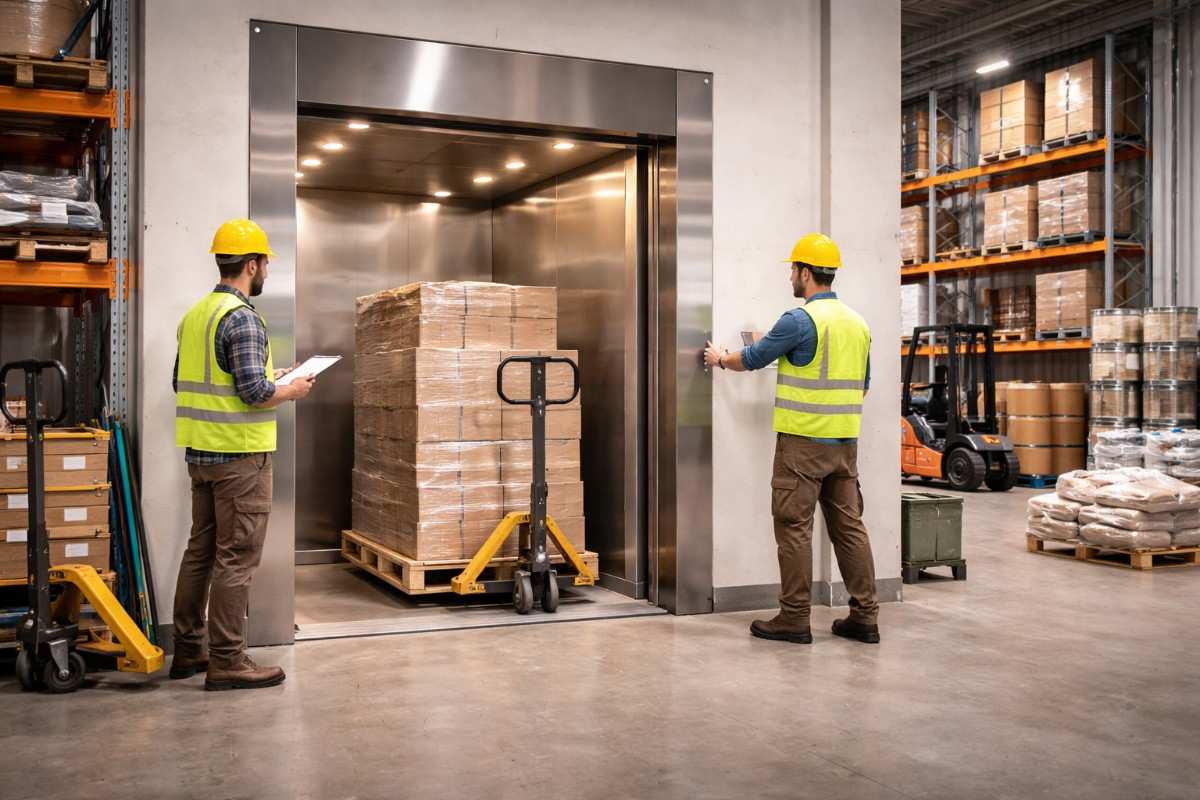
Modern industrial freight elevators are engineered to carry loads ranging from 1000 kg to several tonnes depending on the configuration. Wide platform designs accommodate pallets, large machinery components, barrels, crates, and in heavy-duty versions, even loaded forklifts.
For factories dealing with heavy raw materials like steel, chemicals, automotive components, or large finished goods, this capacity is not just convenient. It is absolutely essential for daily operations.
Benefit 4: Protects Goods from Damage During Movement
Every time a heavy or fragile item is manually carried between floors, there is a risk of damage. Dropped components, scraped surfaces, broken packaging, and crushed goods all represent real financial losses for your business.
An industrial freight elevator moves goods in a controlled, stable, and enclosed platform. There is no tilting, no uneven handling, and no human error in the lifting process. This protection is especially valuable for facilities handling delicate electronics, pharmaceutical products, packaged goods, or precision-engineered components in plants across Delhi and Noida.
Benefit 5: Supports Continuous Operations Without Fatigue
Manual material handling has a natural limit. Workers get tired. Speed slows down. Errors increase. Injuries become more likely as fatigue sets in toward the end of a shift.
An industrial freight elevator does not get tired. It operates at consistent speed and capacity throughout the day, whether it is the first load of the morning or the last one before the night shift ends. For facilities running two or three shifts across Delhi NCR, this consistency in performance is a major operational advantage.
Benefit 6: Improves Facility Space Utilization
Without a dedicated freight elevator, facilities often need to dedicate significant floor space to ramps, inclined conveyors, or manual handling zones. These take up valuable production or storage space that could be used more productively.
An industrial freight elevator operates within a compact vertical shaft, freeing up horizontal floor space for production equipment, storage racks, or additional workstations. For manufacturing units and warehouses in Faridabad and Gurgaon where real estate and floor space come at a premium, this spatial efficiency is a tangible business benefit.
Benefit 7: Reduces Long-Term Labor Costs
When your facility relies on manual labor for floor-to-floor material movement, you are paying multiple workers for a task that a single industrial freight elevator can handle continuously and more efficiently.
Over time, the labor savings from reduced manual handling translate into significant cost reductions. Workers who were previously assigned to material movement can be redeployed to higher-value tasks within the production process, improving overall output without increasing headcount.
Benefit 8: Built for Harsh Industrial Environments
Industrial settings are tough on equipment. Dust, heat, humidity, chemical exposure, and constant heavy use would quickly damage a standard elevator. Industrial freight elevators are specifically engineered to withstand these conditions.
Heavy-duty steel platforms, reinforced doors, robust hydraulic or traction systems, and industrial-grade controls make these elevators capable of performing reliably in the most demanding factory and warehouse environments across India. A well-maintained industrial freight elevator from a quality manufacturer will serve your facility for decades.
Benefit 9: Enhances Compliance with Industrial Safety Regulations
Workplace safety regulations in India are becoming increasingly stringent. Facilities that rely on unsafe manual handling practices or makeshift lifting solutions face growing regulatory scrutiny, inspection failures, and potential penalties.
Installing a certified industrial freight elevator demonstrates your commitment to workplace safety and brings your facility in line with Bureau of Indian Standards norms and relevant industrial safety guidelines. This protects your business from compliance risk and builds trust with clients, auditors, and regulatory bodies.
Benefit 10: Increases Overall Facility Value and Credibility
A facility that is well-equipped with modern infrastructure including an industrial freight elevator sends a clear signal to clients, partners, and investors about the seriousness and professionalism of your operation.
When potential clients visit your factory in Faridabad or warehouse in Noida for an inspection or audit, seeing a properly installed and maintained industrial freight elevator adds to their confidence in your operational capabilities. It is an infrastructure investment that pays returns beyond just day-to-day efficiency.
Industries That Benefit Most from an Industrial Freight Elevator
Industrial freight elevators are not limited to one type of facility. Here are the industries across Delhi NCR where they deliver the most impact.
Manufacturing Plants: Moving raw materials to production floors and finished goods to dispatch areas smoothly and continuously.
Warehouses and Logistics Hubs: Transferring inventory between storage levels quickly and safely without manual labor bottlenecks.
Cold Storage Facilities: Carrying temperature-sensitive goods between floors without delay in controlled environments in Delhi and Noida.
Pharmaceutical Plants: Safely moving sensitive materials, equipment, and packaged products between floors while maintaining hygiene and compliance standards.
Automotive Component Factories: Handling heavy parts, assemblies, and raw materials between production and assembly floors in plants across Faridabad and Gurgaon.
Textile and Garment Units: Moving bolts of fabric, finished garments, and packaging materials between floors of multi-story production facilities.
Food Processing Units: Carrying ingredients, packaging, and finished food products between different production stages on multiple floors.
Industrial Freight Elevator vs Manual Handling: A Direct Comparison
Factor | Industrial Freight Elevator | Manual Handling Load Capacity | Up to several tonnes | Limited by human strength Speed | Consistent throughout the day | Slows with fatigue Safety | High with certified systems | High injury risk Damage to Goods | Minimal | Frequent Labor Required | Minimal | Multiple workers Long-Term Cost | Lower over time | Higher ongoing labor cost Compliance | Meets safety regulations | Often non-compliant Operational Hours | Continuous multi-shift use | Limited by worker fatigue
Why Choose CarryMax Lifts for Your Industrial Freight Elevator
CarryMax Lifts is a leading elevator manufacturer based in Faridabad with deep experience delivering industrial freight elevator solutions to manufacturing plants, warehouses, and industrial facilities across Delhi, Noida, Gurgaon, and the wider Delhi NCR region.
What sets CarryMax apart in the industrial segment is their understanding of real factory and warehouse environments. They do not offer off-the-shelf solutions. Every industrial freight elevator is assessed, designed, and installed based on your specific facility layout, load requirements, floor height, and operational demands.
CarryMax industrial freight elevators are built to Bureau of Indian Standards safety norms and undergo rigorous quality checks before installation. Their systems are designed for continuous heavy-duty use and are built with components that hold up to the toughest industrial conditions.
Their after-sales and maintenance team operates across Delhi NCR with committed response times, ensuring your elevator stays operational and your facility stays productive. Annual Maintenance Contracts are available with clear terms and fast-response service commitments.
For industrial facility owners and plant managers looking for a reliable, experienced, and locally supported elevator partner, CarryMax Lifts is the name most trusted across Faridabad, Delhi, Noida, and Gurgaon.
Frequently Asked Questions
Q1. What is the load capacity of an industrial freight elevator? Industrial freight elevators are available in a wide range of load capacities, typically starting from 1000 kg and going up to several tonnes depending on the application. The right capacity depends on the type of goods your facility handles and the volume of daily material movement. CarryMax Lifts helps you determine the correct specification during the site assessment.
Q2. What types of industrial freight elevators are available? The main types include hydraulic industrial freight elevators, traction freight elevators, and heavy-duty platform lifts. Hydraulic systems are most popular for low to mid-rise industrial buildings due to their high load capacity, simple maintenance, and reliable performance. Traction systems are preferred for taller facilities where higher speed is required.
Q3. How long does it take to install an industrial freight elevator? Installation timelines vary based on the type of elevator, facility layout, and civil work requirements. Typically, industrial freight elevator installation takes between 4 to 10 weeks after the civil shaft work is complete. CarryMax Lifts provides a detailed project timeline before work begins.
Q4. What maintenance does an industrial freight elevator need? Industrial freight elevators in heavy-use environments should be serviced every one to three months. Maintenance includes inspection of hydraulic systems or cables, lubrication of moving parts, safety system testing, platform and door mechanism checks, and electrical system verification. CarryMax Lifts offers structured AMC plans across Delhi NCR.
Q5. Can an industrial freight elevator be installed in an existing factory building? Yes. Industrial freight elevators can be retrofitted into existing industrial buildings with appropriate civil modifications to create or adapt the shaft space. Hydraulic systems are generally more flexible for retrofit installations. A proper site assessment by CarryMax Lifts will identify the most practical approach for your facility.
Q6. What safety features should an industrial freight elevator have? Essential safety features include overload protection, emergency stop systems, door interlock mechanisms, safety buffers at the base of the shaft, automatic rescue during power failure, and limit switches to prevent over-travel. All CarryMax industrial freight elevators are equipped with these safety systems as standard and comply with Bureau of Indian Standards norms.
Q7. Is an industrial freight elevator better than a goods conveyor for my factory? It depends on your specific needs. An industrial freight elevator is better for carrying large, heavy, or irregularly shaped loads between multiple floors with flexibility. Conveyors are better for continuous high-volume movement of uniform items along a fixed path. Many facilities across Delhi NCR use both systems for different purposes within the same operation.
Conclusion
An industrial freight elevator is not just a piece of equipment. It is a fundamental upgrade to the way your facility operates. From eliminating workplace injuries and boosting daily efficiency to protecting goods, reducing labor dependence, and meeting safety compliance requirements, the benefits are practical, measurable, and long-lasting.
For manufacturing plants, warehouses, and industrial facilities across Faridabad, Delhi, Noida, and Gurgaon, the question is no longer whether to install an industrial freight elevator. It is how quickly you can get one in place and start seeing the results.
CarryMax Lifts brings the experience, engineering quality, and local service support to make your industrial freight elevator project smooth, reliable, and built for the long term.
Reach out to CarryMax Lifts today for a free facility assessment and find out exactly which industrial freight elevator solution is right for your operation.